
9 min read
Align Pain & Performance · Clinical case study · The client, Jeff Collins.
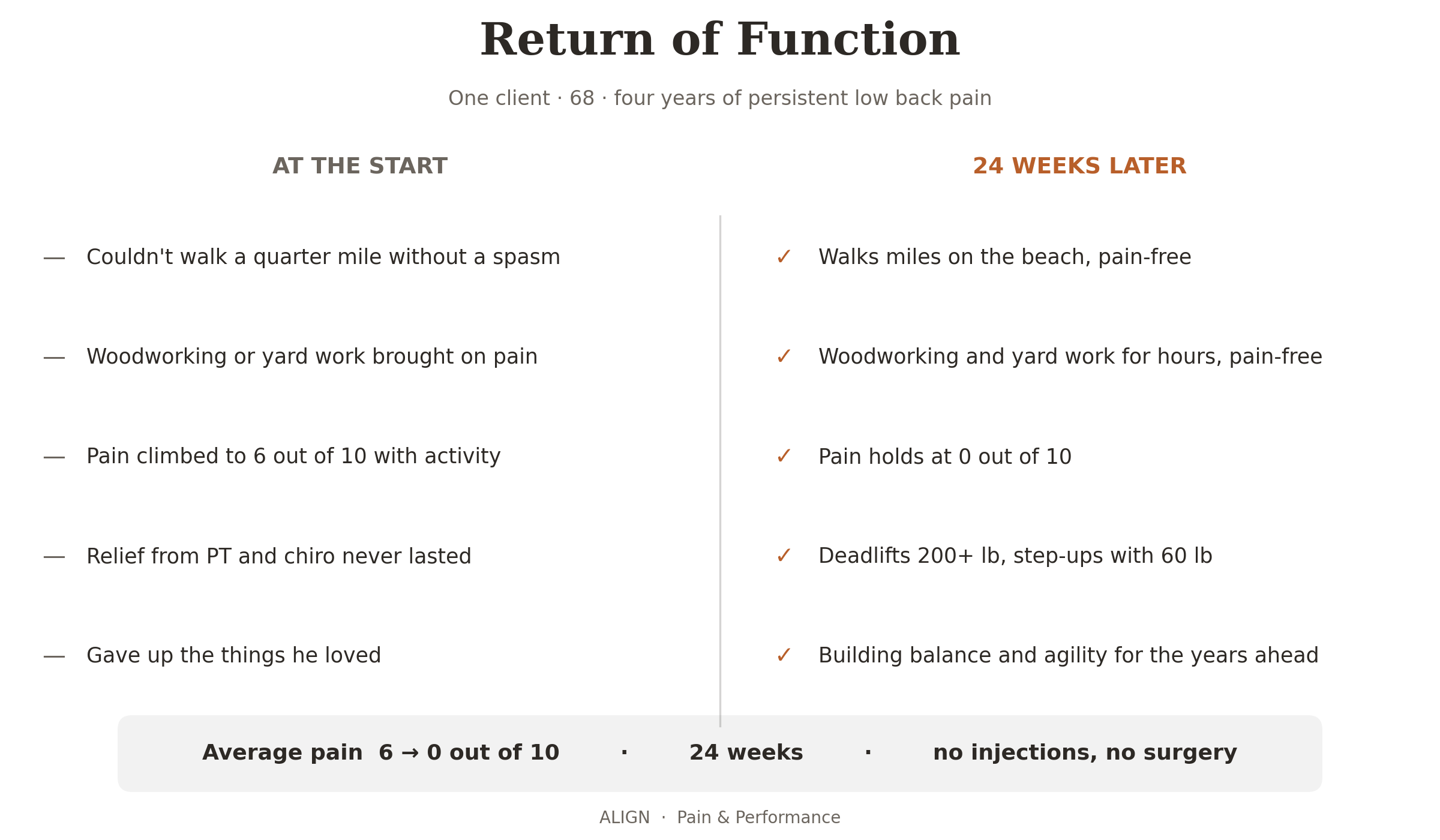
Outcome in one line: A 68-year-old man had lived with low back pain for four years — a constant 3–4 out of 10 that climbed to a 6 out of 10 whenever he tried to live his life, from woodworking and yard work to a walk on the beach that ended in a back spasm. His imaging was clean, a surgeon had ruled out surgery, and physical therapy and chiropractic gave only temporary relief. Across a ~24-week course of mobility, stability, and strength work — no injections, no surgery — his pain resolved to 0 out of 10, and he returned to everything he loved with strength to spare.
Snapshot
Client: Jeff Collins, 68
Duration: 4 years — gradual, non-traumatic, progressively limiting
Location: Central low back, both SI joints, and the sides of the hips
Baseline pain: Constant 3–4 out of 10, climbing to 6 out of 10 whenever he was active
Prior care: Physical therapy (12 sessions), chiropractic, anti-inflammatories; a surgeon ruled out surgery
Pain type (our determination): Chronic, primary mechanical (nociceptive); minimal nervous system or inflammatory contribution
Outcome: Pain 6 → 0 out of 10; full return to his active life
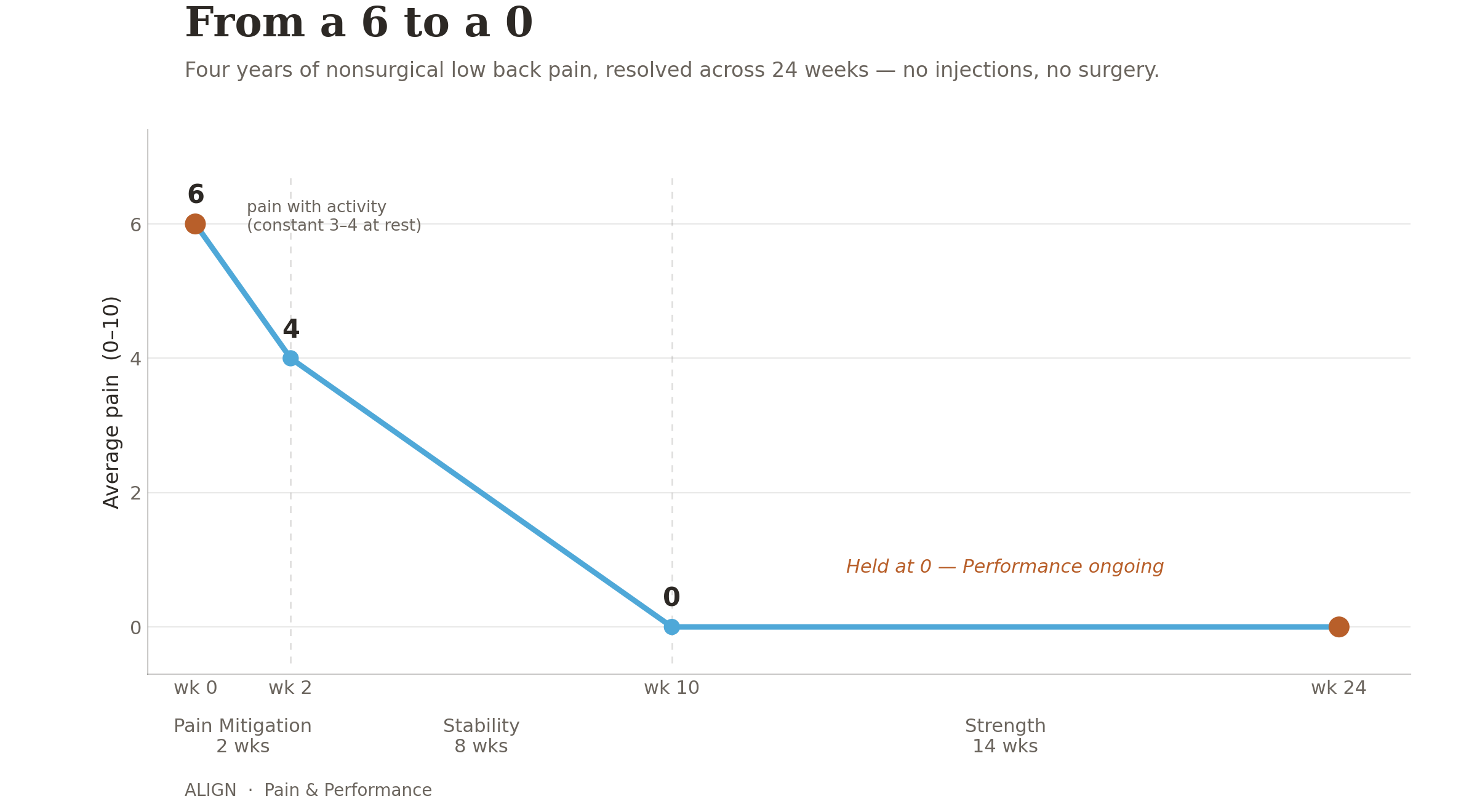
Course: ~24 weeks — Pain Mitigation (2 wks) → Stability (8 wks) → Strength (14 wks), with Performance ongoing
Presentation
The first real limitation showed up on the beach. Jeff tried to walk a quarter mile and his back spasmed. From there it spread into the things he loved and the things he simply had to do — woodworking, working in his yard, and walking all began to trigger regular pain and spasm.
His pain settled into a constant 3–4 out of 10 that climbed to a 6 out of 10 whenever he tried to live his life, which is exactly what kept him from the activities that mattered to him. It was better in the mornings and worse with movement — walking, bending over, lifting, twisting, picking up lumber. Rest, lying down, and ice brought it back down. The pain sat centrally in the low back and across both SI joints, with some pain and stiffness around the sides of his hips.
He had lived at that level for four years. Along the way he tried physical therapy — which helped a little, but once his 12 sessions ended, the pain slowly crept right back up — chiropractic, which also helped but never lasted, and anti-inflammatories. A surgeon reviewed his imaging and determined the pain was not structural, making this a nonsurgical case. What he wanted back was simple: his woodworking, his yard, and his walks.
Health context (relevant to what we would later exclude): 7+ hours of sleep a night; very low stress, anxiety, and depression; a strong social life and a healthy marriage; no history of trauma; and high scores for gratitude and connection.
The Reasoning: A Process of Exclusion
We do not begin by guessing a cause. Persistent low back pain spans roughly 60 contributing variables across three systems — mechanical, immune/inflammatory, and nervous system — cutting across as many as 18 medical specialties. No single diagnosis explains it, and no single specialty owns it. The work is to identify the dominant pain type from presentation, then systematically exclude and resolve probable drivers until the pain is gone.
Step 1 — Acute vs. chronic
Four years of progressive pain with no discrete injury is unambiguously chronic. This is not a fresh injury to be rested and healed; it calls for an entirely different framework.
Step 2 — Pain-type identification
His pain was clearly primary mechanical (nociceptive). The evidence pointed one direction:
Movement and load made it worse; rest made it better. Walking, bending, lifting, and yard work drove the pain; lying down and reducing load relieved it — the signature of load-driven pain.
The pain tracked with mechanical load, not with stress or sleep. His nervous-system profile was clean: good sleep, very low stress and anxiety, strong relationships, no trauma history.
No inflammatory picture. He didn't over-consume refined sugar, didn't drink or smoke, and had no widespread, whole-body inflammatory pain pattern — arguing against an immune/inflammatory driver.
Step 3 — Narrowing the field
Ruling out the nervous system and the immune/inflammatory system excludes the vast majority of the ~60 possible drivers. The surgeon had already excluded structural causes. That leaves only the non-surgical mechanical list, which reduces to three categories:
Mobility — joint range of motion.
Stability — recruitment and neuromuscular control (how load is distributed).
Strength — the load-bearing capacity of the joints and tissues.
He was cleared for movement and exercise.
Assessment Findings
The evaluation found severe, correctable dysfunction across the entire chain.
Mobility — his measured range, with the functional norm for comparison
Big toe extension: 30° (normal is ~60°) — half; this limits push-off in every step.
Ankle dorsiflexion: 20° (normal is ~45°) — restricted.
Hip extension: 0° (normal is ~15°) — the leg couldn't move behind the body at all.
Hip external rotation: 40° (normal is ~90°) — under half.
Hip internal rotation: 10° (normal is ~30°) — a third of normal.
Hip flexion: 45° (normal is ~90°) — half.
Spine rotation: 30° (normal is ~90°) — a third; his trunk could barely rotate.
Stability / recruitment
Poor glute medius recruitment — seen on the outer thigh raise, single-leg stance, and frontal-plane instability while walking.
Weakness and poor recruitment through the hip flexors, TVA, and deep core (front leg raise), the adductors (inner thigh raise), and the glute max (hip extension).
Big toes adducted 30°.
A rotated pelvis — the left hip sat 12° anterior and the right hip 3° anterior; it's that asymmetry, twisting the pelvis, that's the problem (pelvic palpation has questionable accuracy, so we treat this as one biomechanical data point among many).
His low back muscles were compensating for the weak pelvic and spinal stabilizers.
One finding emerged later, since we don't test it at the start: his lumbar erectors were both hypertonic and very weak — overworked yet low-capacity. That is a bad combination: a muscle carrying loads it can't tolerate, with nothing left in reserve.
Why this is good news. Every one of these is correctable. Range can be restored, recruitment retrained, a pelvis re-balanced, and capacity rebuilt. The task was simply to work through them in the right order — restoring enough mobility and control that his back was no longer being asked to do a job it couldn't handle.
The Intervention
Phase 1 — Pain Mitigation (2 weeks)
Goal: restore joint range of motion and correct the pelvic rotation.
We used static, active, and loaded stretches across the whole chain — big toe, ankle, hip extension, hip flexion, hip internal and external rotation, and spine rotation and flexion/extension. Then seated block-and-belt work and cats-and-dogs to correct the pelvic rotation and begin lightly retraining the force-closure mechanism of the SI joint.
Result: range of motion restored to 80–85% of functional targets, pelvic rotation fully corrected, and pain down from 6 to 4 out of 10.
A note on why we moved on before mobility was "perfect": the goal of Pain Mitigation isn't perfect range — mobility keeps improving through the next phase. The goal is to reach 80–85% and calm the overworked muscles so the Stability phase can succeed. Success in one phase is what enables the success of the phase that follows.
Phase 2 — Stability (8 weeks)
Goal: restore recruitment and functional capacity to the key pelvic, spine, and foot/ankle stabilizers — glute medius/minimus, glute max, hip flexors/TVA/pelvic floor, adductors, multifidus, and abductor hallucis (for the arch and big toe).
We built this through outer thigh raises, inner thigh raises, front leg raises, hip bridges, tabletops for the TVA, ankle circles, and banded toe presses — teaching the under-active muscles to do their functional job so load stopped falling on his overworked low back.
Result: pain reached 0 out of 10.
Phase 3 — Strength (14 weeks)
Goal: progressively build strength — 5–10% per week — until Jeff's capacity exceeded the loads of his life by 30–50%.
The work moved onto squats, deadlifts, step-ups, Bulgarian split squats, planks, back extensions, anti-rotations, and calf raises. He built to a 200+ lb deadlift, 12-inch step-ups loaded with 60 lb, 2-minute planks and back extensions, and 30 single-leg calf raises — capacity well beyond what his lifestyle demands, which is what makes daily life feel easy and protects the joints from future injury and degeneration.
Phase 4 — Performance (ongoing)
With pain gone and strength banked, we moved into building balance, agility, and foot speed — for fall prevention, for handling the unexpected demands of life, and simply to make a 68-year-old feel more athletic, graceful, and capable. Performance has no finish line; it's the ongoing work of staying strong for the decades ahead.
Outcome
Baseline: constant 3–4 out of 10, climbing to 6 out of 10 with activity
End of Pain Mitigation (2 weeks): 4 out of 10
End of Stability (+8 weeks): 0 out of 10
End of Strength (+14 weeks): 0 out of 10, capacity 30–50% beyond his lifestyle loads
Performance: ongoing
Pain gone, and held. Jeff walks the beach, does his woodworking, and works in his yard without pain — with a body now strong enough to make all of it easy. Total course to full strength: ~24 weeks, with no injections, no surgery, and no structural intervention.
What This Case Teaches
1. The findings don't cause the pain — load exceeding capacity does. It's tempting to point at a stiff hip or a rotated pelvis and call it "the cause," but pain isn't that simple. On their own, those findings don't generate pain; they concentrate load on the low back. That load only becomes pain when it exceeds what the tissue can tolerate. The same findings in someone who strength-trains produce no pain at all, because their capacity is high enough to absorb the load. That's why the fix is two-sided: lower the load by correcting the findings, and raise the capacity by building strength — until capacity comfortably clears the load. Jeff's pain wasn't a stiff hip; it was focused, heightened load meeting too little capacity to carry it.
2. "Nonsurgical and unresponsive to PT" is not a dead end — it's the exact case we're built for. Physical therapy helped Jeff a little, but it stopped at 12 sessions, and the pain crept back because the work stopped before his capacity was rebuilt. Temporary relief and lasting resolution are different things: one calms the pain for a while; the other finishes the job by building a body that no longer generates it.
3. Success in one phase is what enables the next. We didn't chase perfect mobility before moving on — we restored enough range (80–85%), calmed the overworked muscles, then built stability, then strength. Skip a step and the next one fails. The sequence is the method.
4. A muscle can be overworked and weak at the same time. Jeff's lumbar erectors were both hypertonic and low-capacity — carrying loads they couldn't tolerate, with nothing in reserve. You can't fix that by only stretching them or only strengthening them. You offload them by rebuilding the stabilizers around them, then build their capacity back up.
5. The goal isn't zero pain — it's capacity beyond the demands of your life. We didn't stop when the pain hit zero. We built his strength 30–50% past his lifestyle loads and kept going into balance and agility. At 68, that margin is the difference between staying independent and losing ground — it's what turns "out of pain" into "hard to hurt."