
Case Study — Ten Years of Persistent, Load-Driven Low Back Pain
9 min read
Align Pain & Performance · Clinical case study · The client, Jim Bigelow.
Outcome in one line: A 59-year-old man had lived with central low back pain for 4 years — averaging 5 out of 10, with roughly six major flares a year reaching 7 out of 10 — until bending, squatting, working on his cars, and ordinary daily movement became something he increasingly avoided. Across 20 weeks of mobility, stability, and strength work, followed by ongoing Performance training, his pain reached 0 out of 10, his movement stopped feeling guarded and stiff, and he returned to daily life without expecting movement to cost him days of pain.
Snapshot
- Client: Jim Bigelow, 64
- Duration: 4 years — gradual, non-traumatic onset with recurring flares and progressively increasing movement avoidance
- Location: Central low back
- Baseline pain: 5 out of 10, with approximately six major flares per year reaching 7 out of 10
- Prior care: Physical therapy three times, chiropractic, and exercise; PT and chiropractic had limited effect, while exercise often aggravated his pain
- Pain type (our determination): Chronic, primary mechanical (nociceptive); minimal nervous-system and immune/inflammatory contribution
- Outcome: Pain 5 out of 10, with flares to 7 out of 10, to 0 out of 10; return to unrestricted daily movement and working on his cars
- Course: 20 weeks through Pain Mitigation (2 wks), Stability (6 wks), and Strength (12 wks), followed by ongoing Performance training
Presentation
Jim had lived with central low back pain for 4 years. There was no discrete injury. It came on gradually and settled into a persistent, aching, fatigued feeling through his lower back, averaging 5 out of 10. Roughly six times a year, that escalated into larger flares reaching 7 out of 10, including muscle spasms.
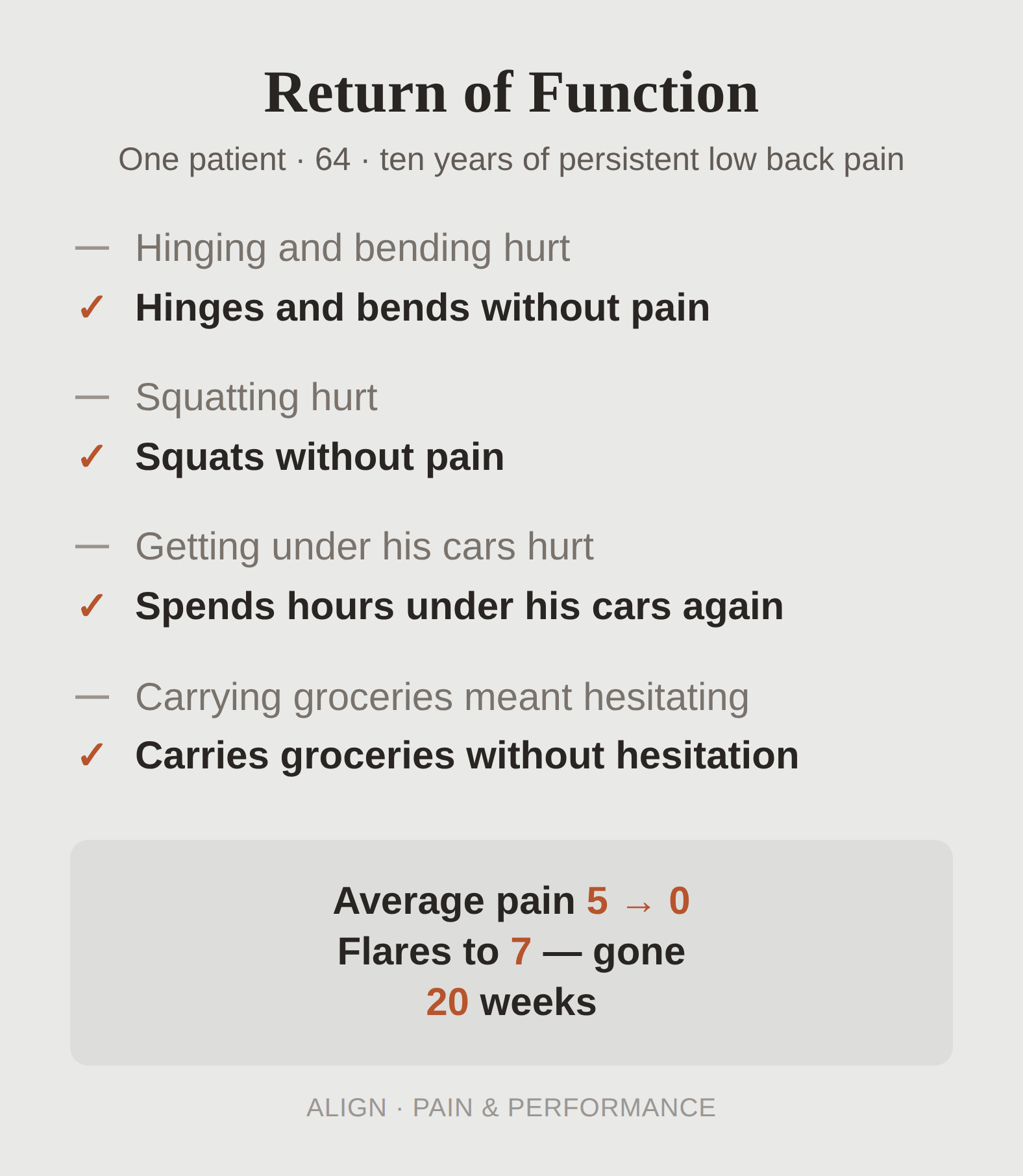
Over time, movement itself became something Jim approached cautiously. Hinging hurt. Squatting hurt. Working on his cars hurt. The pain was generally worse at the end of the day after activity. Bending over, squatting, and other loaded movements aggravated it; rest, lying down, and taking load off made it better.
The result was progressive movement restriction. Pain was a constant burden in Jim's life, making ordinary activities harder and keeping him from moving freely. His passion was working on his cars, but getting down on the floor, getting underneath a car, and spending time working on one had become unpleasant because he expected to pay for it afterward. Even carrying groceries or picking something up from the floor came with hesitation.
He had come to see that burden as part of aging. His father had lived in pain, and Jim assumed constant pain was simply something that happened in your 60s. He expected that getting older would mean gradually giving up more of the activities he loved.
Health context (relevant to the exclusion process): Jim slept 7+ hours, reported low stress and anxiety, strong social connection and gratitude, and no history of trauma. His pain did not meaningfully change with stress or poor sleep; it tracked with physical load. He consumed minimal refined sugar, did not smoke or drink alcohol, and reported no widespread or multi-joint inflammatory pain pattern. Outside the central low back pain, he described his low back and hips—and movement generally—as guarded, tight, and stiff.
The Reasoning: A Process of Exclusion
We do not begin by guessing a cause. Persistent low back pain can involve variables across three primary systems — mechanical, immune/inflammatory, and nervous system. The first job is to identify the dominant pain type from the presentation, then narrow the field based on what the history and assessment actually support.
Step 1 — Acute vs. chronic
Ten years of gradually developing, recurring pain is unambiguously chronic. This was not a fresh injury with an acute healing timeline. Jim's pain had become a persistent problem that progressively changed how he moved and what he was willing to do.
Step 2 — Pain-type identification
Jim's presentation pointed most strongly toward primary mechanical (nociceptive) pain, with minimal nervous-system and immune/inflammatory contribution.
The clearest clue was what changed his symptoms:
- Load increased his pain. Bending, hinging, squatting, working on his cars, and accumulated activity through the day aggravated it.
- Reducing load relieved it. Rest, lying down, and taking load off made him feel better.
- Pain did not track with stress or sleep. He slept 7+ hours, had low stress and anxiety, strong social connection, and no trauma history.
- The inflammatory history was minimal. He reported minimal refined sugar, no smoking or alcohol use, and no widespread or multi-joint inflammatory pain pattern.
Ten years of persistent pain means some sensitization may be present, so nervous-system contribution is best described as minimal, not absent. But the dominant pattern was load-dependent.
Step 3 — Narrowing the field
Jim's history made mechanical factors the priority, while nervous-system and immune/inflammatory contributors moved down the list.
There was one important limitation to the exclusion process: structural pathology had not been formally excluded through imaging or a surgical workup. We therefore cannot claim that structure was ruled out in this case. What we did know was that Jim's doctor had cleared him for exercise and movement.
Within the mechanical system, the assessment focused on three practical categories:
- Mobility — whether the joints had enough range to distribute movement demands.
- Stability — whether the neuromuscular system could control position and distribute load.
- Strength — whether Jim had enough load-bearing capacity for the activities he wanted to perform.
The working model was not that any individual restriction or recruitment finding "caused" Jim's pain. These findings can concentrate mechanical load. Pain becomes more likely when the demands placed on the system exceed its current capacity. The intervention therefore had two jobs: improve the mechanics that were concentrating load and build enough capacity to tolerate the demands of Jim's life.
Assessment Findings
Jim's assessment showed substantial restrictions across the movement chain, combined with deficits in pelvic and trunk stability.
Mobility — measured range, with the functional target for comparison:
- Big toe extension measured 60° (normal is ~90°) — restricted push-off range at the foot.
- Ankle dorsiflexion measured 30° (normal is ~45°) — reduced forward movement available through the ankle.
- Hip extension measured 0° (normal is ~15°) — the hip had essentially no available extension beyond neutral.
- Hip external rotation measured 50° (normal is ~90°) — substantially restricted rotational range.
- Hip internal rotation measured 15° (normal is ~30°) — approximately half the target range.
- Hip flexion measured 45° (normal is ~90°) — substantially restricted flexion range.
- Thoracic rotation measured 45° (normal is ~90°) — approximately half the target rotational range.
- Thoracic extension measured 5° (normal is ~30°) — very little extension available through the thoracic spine.
Stability / recruitment
Jim's pelvis was rotated, with the left hip measured 3° posterior and the right hip 10° anterior.
His glute medius was under-active, evident both in his gait cycle and on the outer thigh raise assessment, with TFL dominance. His left psoas/hip flexors were under-active, while coordination and stability between the diaphragm, TVA, and pelvic floor were poor. His inner thighs were under-active bilaterally, as were both glute max muscles.
Taken together, his frontal-plane stabilizers, anterior sling, and posterior sling were not providing adequate stability. At the SI joint, poor stability was accompanied by significant force-closure failures.
Other tissues were compensating for that lack of contribution. Jim carried increased tightness through the TFLs, hamstrings, quads, and lumbar erectors, with the lumbar erectors chronically loaded.
None of these findings, individually or collectively, should be described as the direct cause of his pain. They provided a mechanical picture in which movement and load could become concentrated through a system that did not yet have enough capacity to tolerate the demands Jim placed on it.
The Intervention
Phase 1 — Pain Mitigation (2 weeks)
Goal: restore available range of motion, eliminate the pelvic rotation, reduce unnecessary guarding, and begin rebuilding SI force closure.
We used long-exhale breathing to downregulate the nervous system, alongside a combination of static and active stretching for ankle dorsiflexion, hip internal rotation, hip external rotation, spinal rotation, and spinal flexion/extension.
For hip extension and hip flexion, Jim performed low-back/SI-supported loaded stretches. We also used seated block squeezes and belt presses to eliminate the pelvic rotation and begin retraining the force-closure mechanism of the SI joint.
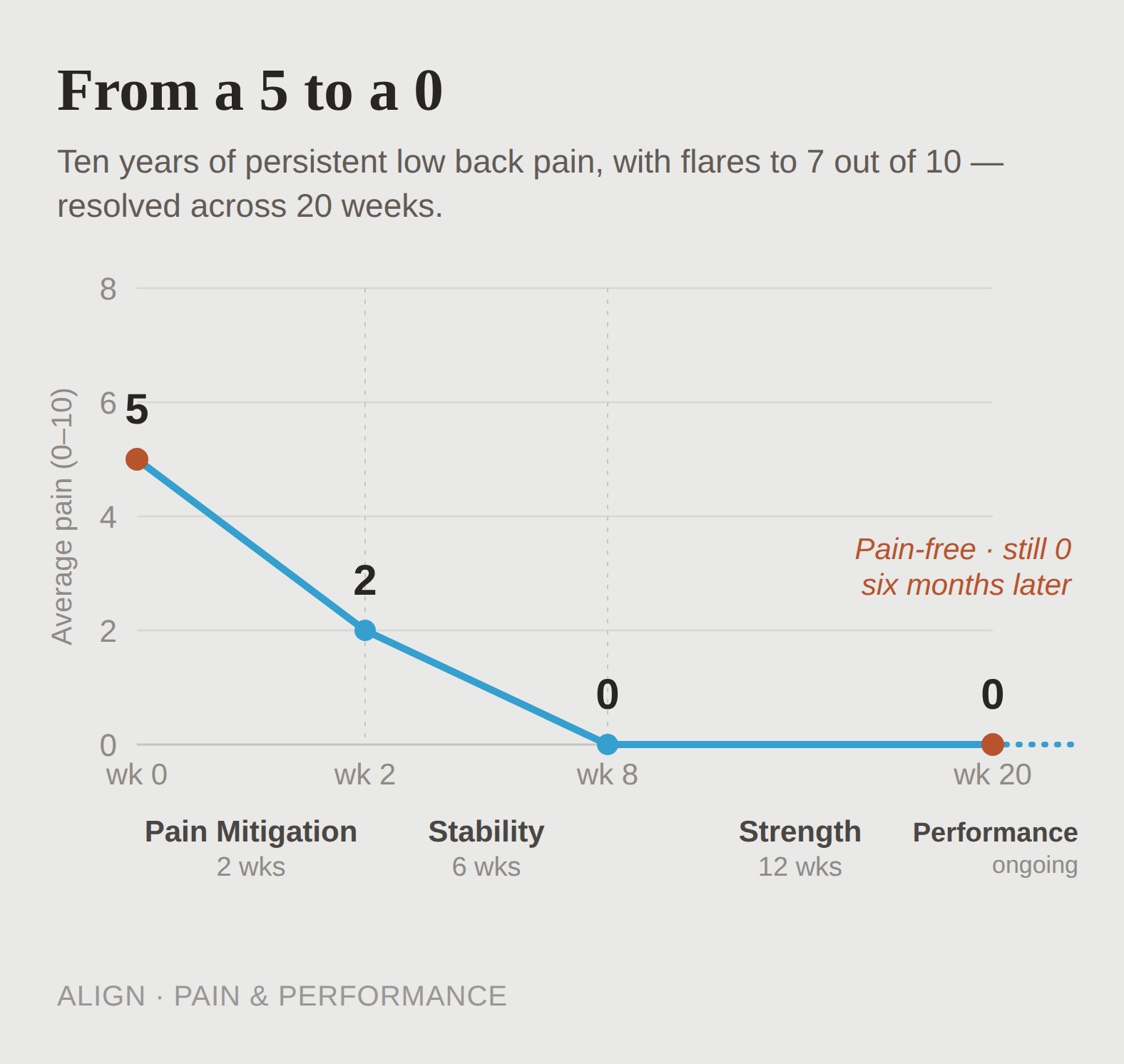
Result: after 2 weeks, range of motion was nearly completely restored, the pelvic rotation had been eliminated, and average pain had fallen from 5 out of 10 to 2 out of 10.
Phase 2 — Stability (6 weeks)
Goal: restore recruitment and functional capacity to the key pelvic and spinal stabilizers — including glute medius/minimus, glute max, hip flexors, TVA/pelvic floor, adductors, and multifidus.
We used TVA breathing to restore coordination between the TVA, diaphragm, and pelvic floor, then built stability through wall-supported clamshells, outer thigh raises, inner thigh raises, front leg raises, hip bridges, and tabletops for the TVA.
The purpose was to improve the contribution of the under-active muscles so that load could be distributed more effectively instead of repeatedly concentrating through Jim's overworked low back. This work also restored SI stability.
Result: pain reached 0 out of 10. Jim's sense that movement was inherently stiff and guarded was gone. He displayed greater trust in his body and less fear of movement.
Phase 3 — Strength (12 weeks)
Goal: maintain the restored mobility and stability while raising Jim's load-bearing capacity well beyond the demands of everyday life.
Jim spent 12 weeks in lower-body strength training. The exercises mapped directly onto important lifestyle movement patterns: squats, deadlifts, step-ups, Bulgarian split squats, planks, back extensions, anti-rotations, and calf raises.
By the end of the phase, Jim had built to:
- 205-lb deadlift
- 80-lb Bulgarian split squat
- 2-minute plank
- 2-minute back extension
Result: pain remained at 0 out of 10. The dramatic increase in strength meant the loads involved in Jim's everyday activities now sat well within his available capacity.
Phase 4 — Performance (ongoing)
Jim has continued in Performance for six months at the time of this case write-up.
The work continues to build strength while adding balance, agility, proprioception, and fall prevention. This is the performance-and-longevity phase: rather than treating pain resolution as the finish line, the goal is to continue developing the physical capacity needed for the years ahead.
Outcome
- Baseline: 5 out of 10, with approximately six flares per year reaching 7 out of 10
- End of Pain Mitigation (2 weeks): 2 out of 10
- End of Stability (+6 weeks): 0 out of 10
- End of Strength (+12 weeks): 0 out of 10
- Performance: 0 out of 10; ongoing for six months at the time of writing
Jim can now hinge, squat, carry groceries, get on and off the floor, get underneath a car, and work on his cars without expecting movement to punish him afterward. He no longer assumes that picking something up from the floor will hurt, or that working on a car will leave him sore, in pain, and hobbling for days. Most importantly, he is no longer afraid of moving. The constant burden of anticipating pain is no longer dictating how he lives his life.
What This Case Teaches
1. The findings don't cause pain — load exceeding capacity is the problem we can change. Jim had restricted joints, under-active stabilizers, an asymmetrically positioned pelvis, poor SI stability, and chronically loaded lumbar erectors. Those findings matter because they can change how load is distributed; they are not, by themselves, a declaration of what "caused" his pain. The intervention worked on both sides of the equation: reduce concentrated load by restoring mobility and stability, then raise capacity through progressive strength and Performance training. By the end, ordinary life demanded far less than Jim's body was capable of handling.
2. Pain is information, not proof that decline is an inevitable part of aging. Jim had watched his father live in pain and assumed the same future awaited him. He thought constant pain in his 60s was normal and that getting older would mean progressively surrendering the activities he loved. His experience challenged that assumption. Pain is communication from the brain: a signal worth investigating rather than automatically accepting as the price of age.
The "check engine light" analogy is useful here. The light is not itself the mechanical problem; it is an alert that deserves attention. Ignoring the alert does not tell you what is happening underneath it. Neither does simply trying to silence it. The useful response is curiosity: what is the signal responding to, and what does that tell us to investigate?
3. Listen carefully to what makes pain better and worse. Aggravating and relieving factors are valuable clues when determining which system deserves priority. Jim's pain consistently increased with movement and mechanical load and decreased when load was removed. Stress and poor sleep did not meaningfully change it. His inflammatory history was also minimal. That pattern made the mechanical system the dominant working hypothesis.
The distinction matters. Pain that reliably tracks with load presents a different clinical picture from pain that strongly tracks with stress, fear, or sleep disruption. The mechanical, nervous, and immune/inflammatory systems can overlap, particularly after years of persistent pain, but identifying the dominant pattern helps determine where to start.
4. Movement avoidance solves today's problem by creating tomorrow's limitation. Jim's response to pain made sense in the short term: if hinging hurts, hinge less; if squatting hurts, stop squatting; if working on the car produces days of consequences, think twice before doing it. But repeatedly avoiding movement also means fewer opportunities to maintain and build physical capacity.
Over time, Jim's world had become smaller. The answer was not to demand that he simply ignore pain and move more. It was to systematically restore enough mobility and stability to make movement tolerable, then progressively build the capacity required to make those movements easy.
5. Reaching 0 out of 10 pain is not the end of the process. Jim reached 0 out of 10 during Stability, before his 12-week Strength phase even began. Stopping there would have confused symptom resolution with full physical preparation. Strength raised the ceiling; Performance continues to raise it through strength, balance, agility, proprioception, and fall-prevention work. The long-term objective is not merely to escape pain. It is to build and maintain enough capacity to keep doing the things that make Jim's life his own.