
Case Study — Persistent SI Joint and Tailbone Pain
8 min read
Align Pain & Performance · Clinical case study · The client, Tamara Warren.
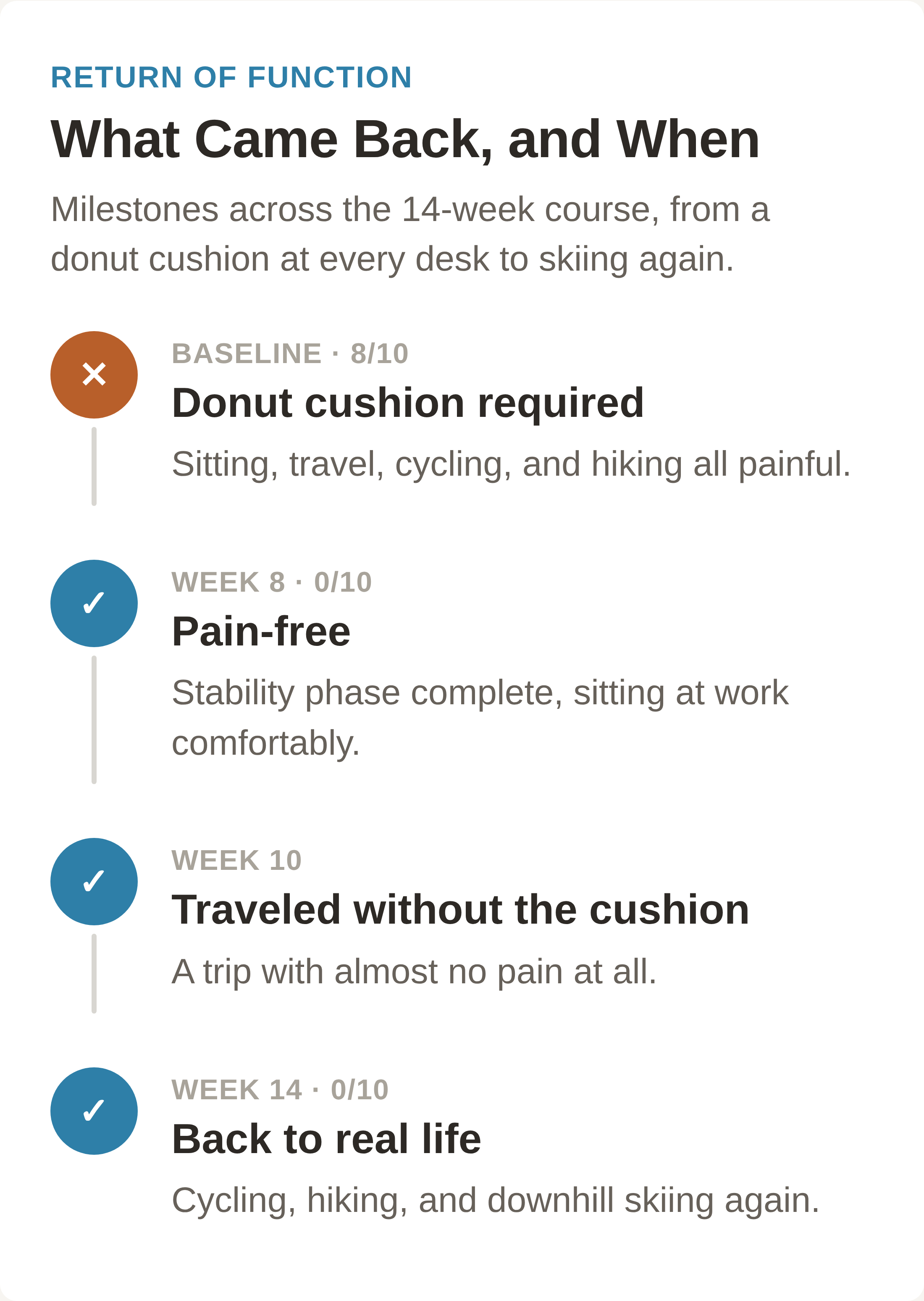
Outcome in one line: A woman in her late 50s developed persistent tailbone and SI joint pain gradually, with no single triggering event. By the time she started at Align, pain was 8 out of 10 and had made sitting, work, travel, bicycling, hiking, and skiing increasingly difficult. Her pelvic rotation improved within the first few days of treatment, tailbone pain decreased over the following 2–3 weeks, and by week 8 her pain was 0 out of 10; after another six weeks of strength work, she was sitting comfortably, traveling without a donut cushion, and back to bicycling, power walking, and skiing with no residual symptoms.
Snapshot
- Client: Tamara Warren, female, late 50s
- Duration: About 1 year before starting Align — pain became significant in summer 2023, with gradual onset and no single triggering event
- Location: Tailbone, SI region, and low back
- Baseline pain: 8 out of 10
- Prior care: Primary care evaluation, pain medication to function, massage, physical therapy referral (physical therapy had not been helpful historically), X-rays, attempted surgical consultation
- Pain type (our determination): Chronic, primary mechanical (nociceptive); minimal nervous-system and inflammatory contribution
- Outcome: Pain 8 out of 10 to 0 out of 10; full return to sitting, work, travel, bicycling, power walking, hiking, and skiing
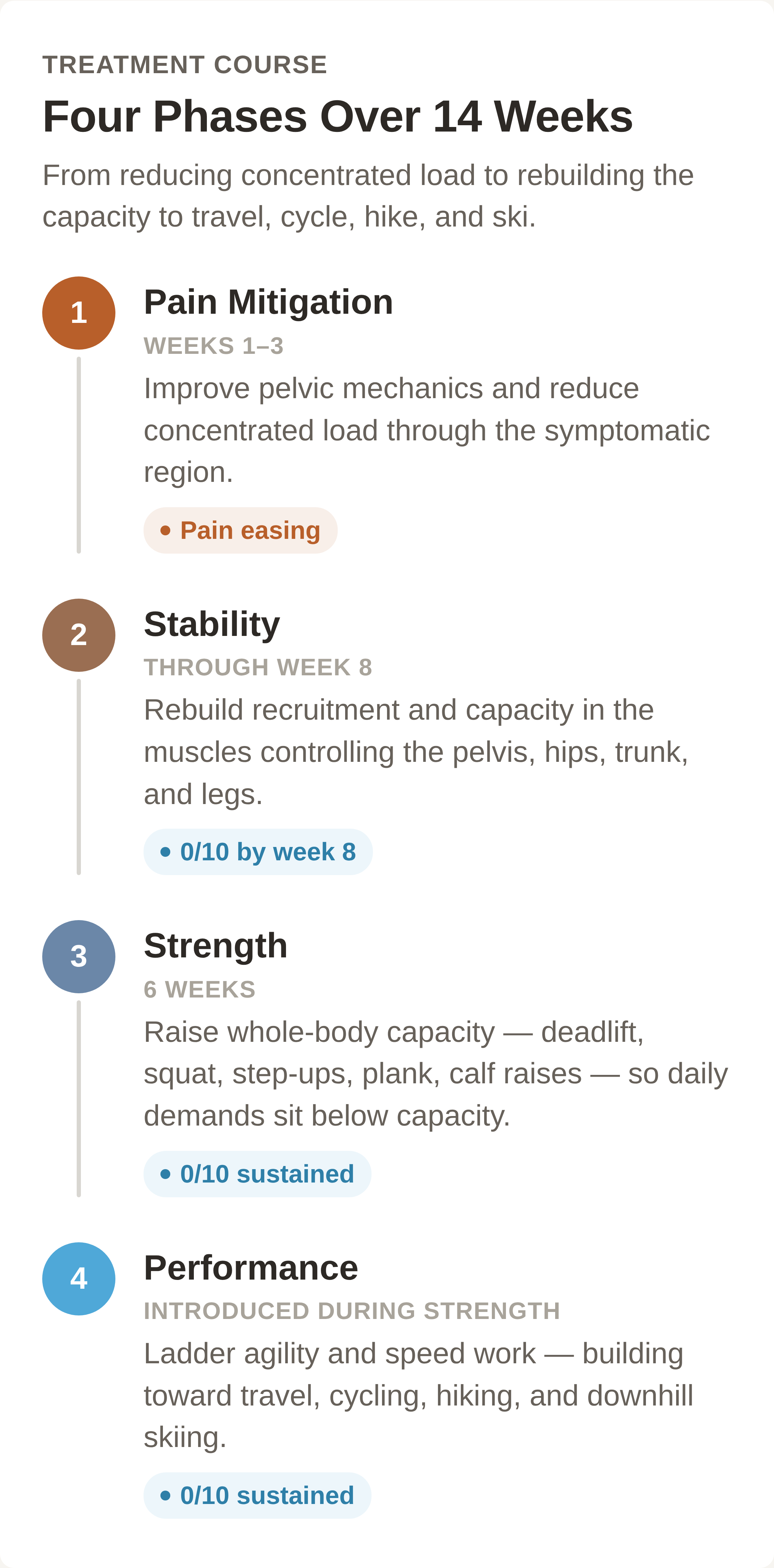
- Course: ~14 weeks — Pain Mitigation and Stability through week 8, followed by 6 weeks of Strength with agility/speed work introduced
Presentation
Tamara had always been active. Before the pain began, she regularly bicycled, hiked, power walked, and skied. As she entered her late 50s, she had already become somewhat less active and was unhappy about it. When she tried to ramp activity back up, she would sometimes overdo it and then slide back toward inactivity. At the same time, she was coordinating care for aging parents, eventually moving her mother across the country to live near her before her mother passed away. She also worked a busy, stressful job that she loved.
The pain became significant in the summer of 2023. There was no single triggering event that she could identify. Her tailbone gradually became very painful, and at first she thought she could simply wait for it to go away.
Instead, the pain became constant. Tamara reported that it was with her every minute, even while sleeping. She generally preferred not to take pain medication, but at that stage she used it in order to function.
Sitting was especially difficult. She needed a donut cushion everywhere — at home, at work, in the car, while visiting family, and on airplanes. Even with the cushion, sitting remained rough. Driving became grueling. She also had SI-region pain above the tailbone but below the low back.
The pain changed how she moved through the rest of her life. She stayed off her bicycle for more than a year. She shortened her hikes. Her power walks became more like strolls. She skied less often because she was afraid of falling and making the problem worse.
By the time she started at Align, her pain level was 8 out of 10.
Mornings were generally okay. Lying down relieved symptoms. Prolonged sitting, driving, flying, train travel, bicycling, walking, and hiking aggravated them. Bending did not aggravate the tailbone itself, but it did aggravate the SI region.
After several weeks of hoping the problem would settle on its own, Tamara saw her doctor. X-rays reportedly showed that her tailbone was deformed, and she was told she would most likely need surgery. She then spent several weeks unsuccessfully trying to connect with a back surgeon’s office. Around that time, people she knew recommended Align, and she decided to try a different path.
She had also tried massage and had been referred to physical therapy; historically, physical therapy had not been helpful for her. She was medically cleared to exercise.
Her sleep had generally been okay before the pain became severe, although the pain itself was eventually present even during sleep. Work stress was high, and being forced to sit in pain made that stress worse. Anxiety was not extreme, but it increased as she lost access to the activities she loved. Her inflammatory picture was already well controlled through hydration and nutrition.
The functional goal was not merely to tolerate a chair. Tamara wanted to work comfortably, travel, bicycle, hike, power walk, ski, and feel physically capable again.
The Reasoning: A Process of Exclusion
We do not begin by guessing a cause. Persistent pain can involve mechanical, immune/inflammatory, and nervous-system contributors. The task is to identify the dominant pain type from the presentation, exclude higher-priority medical and structural concerns, and then test the remaining mechanical contributors through assessment and response to intervention.
This case also required clinical humility. At the beginning, we did not know how much of Tamara’s pain was biomechanical. We did not know whether changing pelvic mechanics would substantially affect the tailbone symptoms, and we could not assume that the tailbone appearance on X-ray explained the pain.
Step 1 — Acute vs. chronic
Tamara’s symptoms had persisted for many months, with no discrete injury and no single traumatic onset. That made the presentation clearly chronic, rather than an acute injury that could be explained by a recent tissue-damage event.
Step 2 — Pain-type identification
The dominant presentation was mechanical (nociceptive).
The strongest evidence came from what changed her symptoms:
- Direct pressure and prolonged sitting were highly provocative.
- Driving, flying, train travel, bicycling, walking, and hiking aggravated symptoms.
- Bending aggravated the SI region.
- Lying down and unloading the area relieved symptoms.
- Mornings were generally okay.
- Work stress and anxiety were present, but the coach did not report a clear pattern in which stress or anxiety independently drove the pain.
- Hydration and nutrition were already being managed, with no reported widespread inflammatory pattern.
The fact that the pain had become constant, including during sleep, meant we could not treat the case as purely simple load-response pain at presentation. Chronic pain can involve sensitization even when mechanics remain the dominant driver. For that reason, we describe nervous-system and inflammatory contribution as minimal, not absent.
Step 3 — Narrowing the field
Tamara had undergone X-rays and had been told surgery would most likely be needed. She was medically cleared for exercise, and surgery had not yet occurred.
Importantly, the X-ray finding did not give us permission to declare the tailbone shape the source of her pain. The remaining mechanical assessment therefore focused on variables we could measure and change: mobility, stability, and strength.
The useful question was not, “Which single finding causes the pain?”
It was: Where is load being concentrated, how much capacity does the system have to tolerate that load, and what changes when we improve those variables?
Assessment Findings
The assessment showed that Tamara’s mobility was generally adequate, with two notable restrictions.
Mobility
- Hip external rotation measured 50° (normal is ~90°) — substantially restricted rotational range at the hip.
- Hip flexion measured 60° (normal is ~90°) — restricted forward hip range.
- Other assessed mobility was adequate.
Pelvic position / stability
- Right pelvic position measured -3°.
- Left pelvic position measured -1°.
- The coach characterized this pattern as posterior pelvic rotation.
Recruitment and strength readiness
- The glutes were weak and under-active.
- The iliopsoas was weak and under-active.
- The TVA was under-active.
- The hamstrings, quadriceps, and calves showed reduced muscle mass and strength.
These findings do not, by themselves, “cause” SI or tailbone pain. They can change how forces are distributed through the pelvis and surrounding tissues. Pain occurs when the load being concentrated in an area exceeds the capacity of the tissues to tolerate it.
That distinction was especially important here because the tailbone itself was never reassessed radiographically. We could change Tamara’s mechanics and capacity and observe what happened to her symptoms; we could not claim that we changed the tailbone’s position or shape based on symptoms alone.
The Intervention
Phase 1 — Pain Mitigation (first 2–3 weeks)
Goal: improve pelvic mechanics, reduce concentrated load through the symptomatic region, and create enough improvement to begin rebuilding stability.
The primary positional intervention was seated belt-and-block work.
Tamara’s pelvic rotation improved within the first 2–3 days. Belt-and-block work continued after that initial change rather than stopping as soon as the pelvic measurements improved.
Tamara later described those simple exercises as unexpectedly important. At first, she wondered what such basic movements could possibly do for her; over time, she came to see them as foundational tools she could continue using to manage her body.
Over approximately 2–3 weeks, her tailbone pain also decreased.
There was no follow-up X-ray, so we cannot say that the tailbone physically “shifted back into place” or changed shape. What we can say is that the measured pelvic rotation improved rapidly, and the tailbone symptoms subsequently decreased.
A separate pain score was not recorded specifically at the end of this early Pain Mitigation period.
Phase 2 — Stability (through week 8)
Goal: rebuild recruitment and capacity through the muscles responsible for controlling the pelvis, hips, trunk, and lower extremities.
The program included:
- Outer thigh raises
- Front leg raises
- Inner thigh raises
- Static tabletop holds for TVA work
- Calf raises
- Ankle circles
- Hip bridges
- Sit-to-stands
- Continued seated belt-and-block work as needed
The glutes, iliopsoas, and TVA were treated as under-active muscles that needed progressive recruitment and loading, while the lower extremities needed capacity rebuilt after the observed loss of muscle mass and strength.
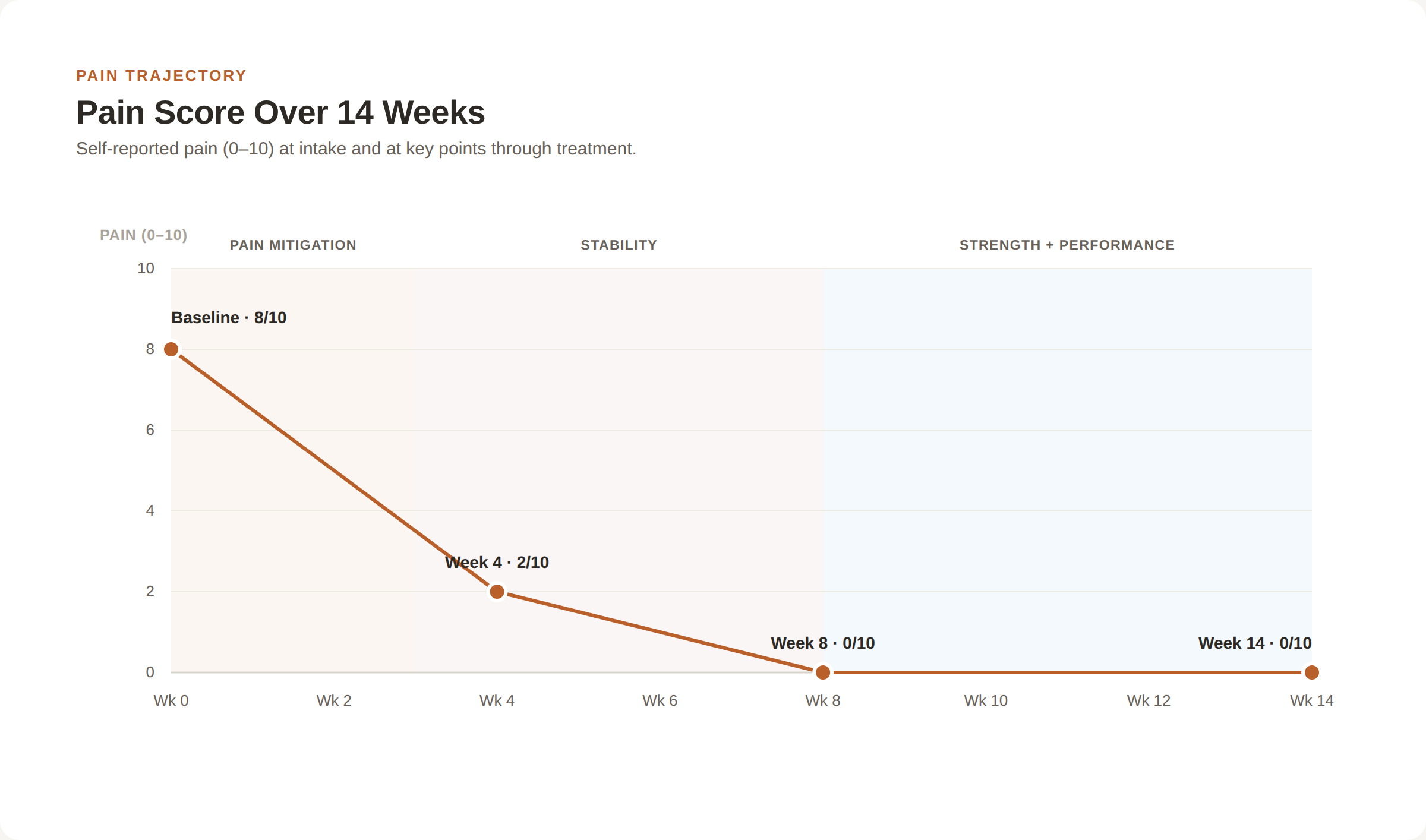
By week 4, Tamara’s pain had fallen from 8 out of 10 to 2 out of 10.
By week 8, her pain was 0 out of 10.
Pain relief was not the endpoint. At that stage, the priority shifted toward building enough strength that the physical demands of Tamara’s life would sit comfortably below her capacity.
Phase 3 — Strength (6 weeks)
Goal: raise whole-body capacity so Tamara could return to an active life without symptoms.
Over the next six weeks, the program progressed into heavier strength work.
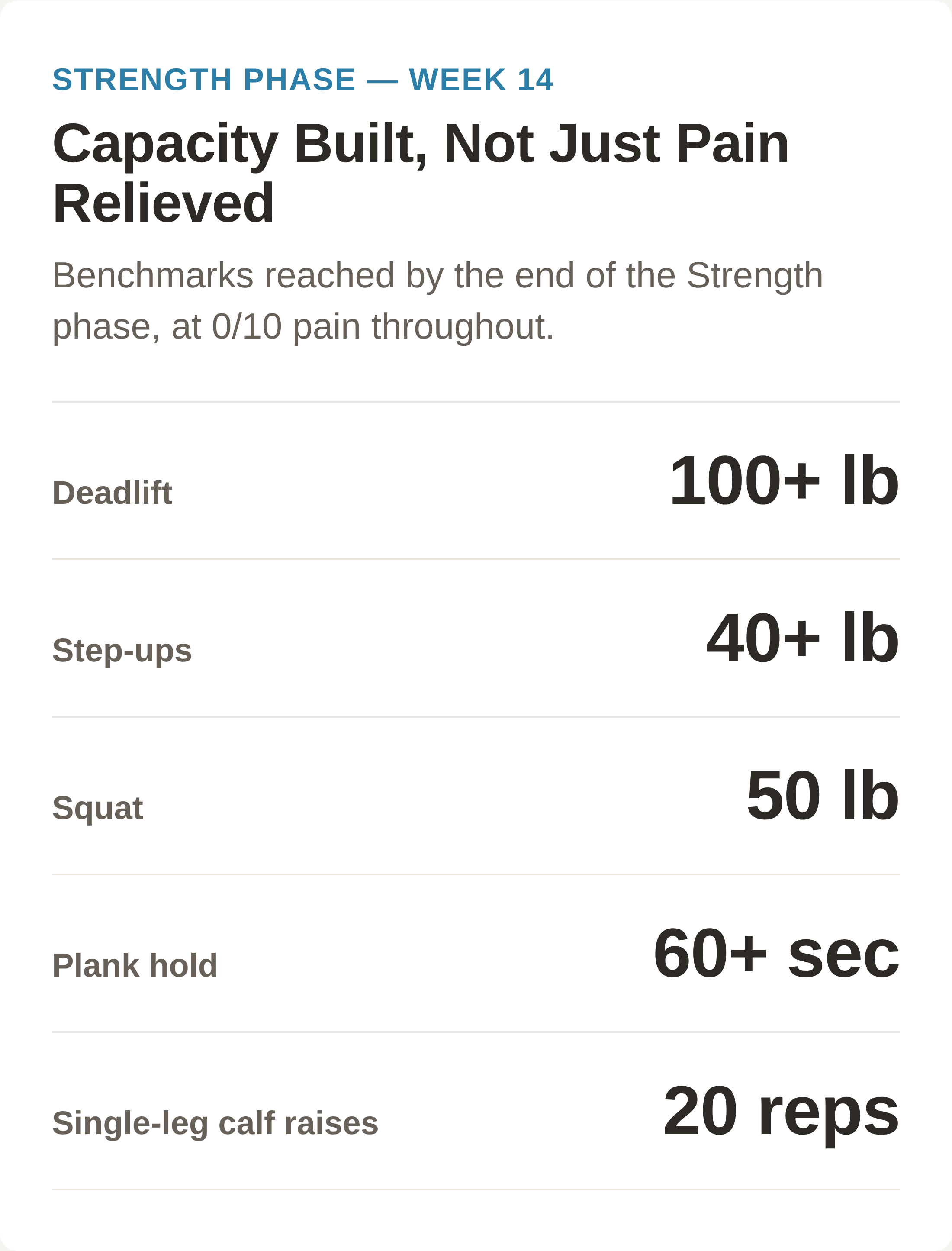
Benchmarks built:
- Deadlift: over 100 lb
- Step-ups: over 40 lb
- Squat: 50 lb
- Plank: over 1 minute
- Single-leg calf raises: 20 reps
Phase 4 — Performance
Performance elements were introduced through ladder agility and speed work as Tamara’s strength progressed.
This mattered because her goals were not sedentary. She wanted to travel, bicycle, power walk, hike, and return to skiing. Building capacity for those activities required moving beyond symptom reduction and back toward athletic movement.
Outcome
- Baseline: 8 out of 10
- Week 4: 2 out of 10
- End of Stability (week 8): 0 out of 10
- During Strength — travel at week 10: almost no pain; traveled without her donut cushion
- End of Strength (week 14): 0 out of 10
- Final status: 0 out of 10 with no residual SI or tailbone symptoms
The practical change was substantial.
At the beginning, Tamara needed a donut cushion everywhere she sat and described sitting in the car as grueling. She had stopped bicycling for more than a year, shortened her hikes, slowed her power walks, and skied less often because she was afraid of making the problem worse.
At approximately week 10, she took a trip and had almost no pain — and did not need to bring her donut cushion.
By the end of the program, she could sit comfortably at her desk, travel, bicycle, power walk, and ski again. Her SI and tailbone symptoms had resolved, and there were no residual symptoms reported.
She also described a broader shift in how she viewed her health: rather than treating fitness as a destination, she came to see regular movement and strength work as ongoing maintenance for the life she wanted to keep living.
What This Case Teaches
1. A structural change found on imaging is not automatically the cause of pain. Tamara arrived with an X-ray reportedly showing a deformed tailbone, but we did not know how much that structural finding contributed to her symptoms. Imaging can identify structural changes, but the presence of a finding does not establish that it is the source of pain. In Tamara’s case, the rapid change in symptoms as her mechanics improved gave us important information that the X-ray alone could not.
2. The clinically useful question is whether changing load changes pain. Tamara’s pelvic rotation improved within days. Her tailbone pain then decreased substantially over the following 2–3 weeks. We cannot say the tailbone moved or changed shape because no follow-up X-ray was performed. We can say that changing her pelvic mechanics coincided with a rapid reduction in symptoms. That response strengthened the evidence that mechanics were an important contributor in her case.
3. Findings concentrate load; pain emerges when load exceeds capacity. Restricted hip motion, altered pelvic position, under-active stabilizers, and low lower-extremity strength can change where physical forces are absorbed. None needs to be labeled “the cause.” The intervention works from both sides of the equation: reduce concentrated load by improving mechanics and raise capacity through progressive stability and strength work.
4. Getting out of pain was only the first half of the job. Tamara reached 0 out of 10 by week 8, but the program continued for another six weeks. She progressed to a deadlift over 100 lb, step-ups over 40 lb, a 50 lb squat, planks beyond one minute, single-leg calf raises, and agility work. The goal was not merely a quieter tailbone. It was enough capacity to travel, bicycle, hike, power walk, ski, work, and live without those demands repeatedly exceeding what her body could tolerate.
5. Response to intervention can clarify a case that is uncertain at the start. We did not begin knowing how much of Tamara’s pain was biomechanical. Her rapid response supplied information the initial assessment could not. As pelvic mechanics improved, pain fell; as stability and strength increased, symptoms reached 0 out of 10 and stayed there. The sequence helped clarify the clinical picture without requiring us to invent certainty that was not present at the beginning.