
Case study — Three Years of Persistent Right-Sided Low Back Pain
(8 min read)
Align Pain & Performance · Clinical case study · Anonymized (composite details where needed).
Outcome in one line: A 65-year-old woman with three years of persistent, progressive right-sided low back pain — average pain 7/10, and who felt she had "tried everything" — returned to a pain level of 0 and full lifestyle function across a ~23-week course of mobility, stability, and strength work, with no structural intervention.
Snapshot
Patient: Female, 65 (anonymized)
Duration: 3 years — gradual onset, progressive
Location: Right low back, SI joint, and hip
Baseline pain: 7/10 average; worse in mornings (first ~3 hours "miserable")
Prior care: Cortisone injections, physical therapy, chiropractic; MRI with normal degenerative findings that did not explain the pain
Pain type (our determination): Chronic, primary mechanical (nociceptive); minimal nervous-system contribution
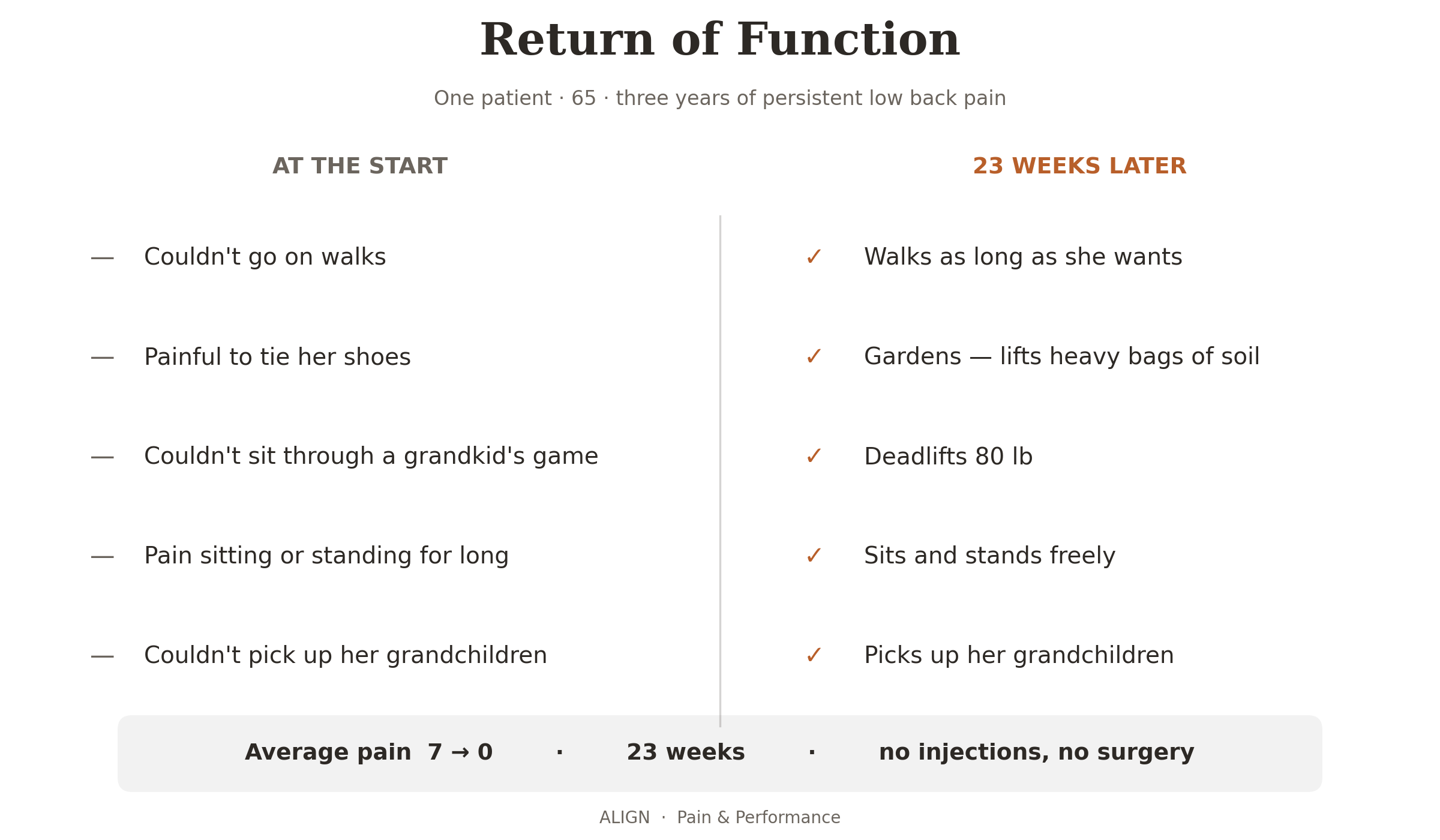
Outcome: Average pain 7 → 0; full return of function
Course: ~23 weeks — Pain Mitigation (3 wks) → Stability (8 wks) → Strength (12 wks)
Presentation
The patient reported three years of persistent low back pain, isolated to the right side of the low back, the SI joint, and the hip. Onset was gradual, with no discrete injury, and the pain had progressively worsened over time. Average pain was 7/10, consistently worse in the mornings — she described the first three hours of each day as miserable.
Aggravating: walking, sitting, picking objects off the floor, and climbing stairs.
Relieving: lying down.
The functional cost was significant. She could not go on walks. Bending to tie her shoes was painful. Prolonged sitting was painful. She could no longer sit on the bleachers to watch her grandchildren's sporting events. Her stated goals were concrete and ordinary: long walks, going to the movies, working in her garden, and watching her grandkids play sports. She felt she could do none of it.
By the time she reached us she reported feeling that she had tried everything, and she was hopeless and confused.
Health context (relevant to what we would later exclude): 7+ hours of sleep per night, low anxiety, 60+ oz of water per day, no medications, strong social connections, and no history of PTSD, trauma, or abuse.
The Reasoning: A Process of Exclusion
We do not begin by guessing a cause. Persistent low back pain spans roughly 60 contributing variables across three systems — mechanical, immune/inflammatory, and nervous — and those variables cut across as many as 18 medical specialties. No single diagnosis explains it, and no single specialty owns it. The work is to identify the pain type from presentation, then systematically exclude and resolve probable drivers until the pain is gone.
Step 1 — Acute vs. chronic
Acute pain (with obvious trigger and tissue damage, resolving with healing) belongs with a GP or physical therapist. This was unambiguously chronic — well beyond the three-month mark, in fact three years — with no discrete injury and progressive worsening. That routing decision alone reframes the entire approach.
Step 2 — Pain-type identification
Three chronic pain mechanisms can present: mechanical (nociceptive), nervous-system (nociplastic), and neuropathic. Hers was clearly primary mechanical with little to no nervous-system driver. The determination came from what changed her pain:
Mechanical demand made it worse; reducing mechanical demand made it better. This is the signature of nociceptive, load-driven pain.
Variations in stress, sleep, hydration, and sugar had no effect on her pain — arguing against a meaningful nervous-system contribution.
She carried none of the major risk factors for nervous-system-dominant pain: no sleep disturbance, no elevated anxiety, no widespread pain, no history of trauma or abuse.
The only nervous-system amplifier in the picture was the duration itself — three years of pain can produce some peripheral and central sensitization. Noted, but not the primary lever.
Step 3 — Narrowing the field
Those ~60 possible contributing pain drivers are spread across three systems — mechanical, immune/inflammatory, and nervous system. Because her pain was clearly mechanical, her likely drivers will concentrate in the mechanical share of that list, and the immune and nervous-system contributors drop down the priority order. Her MRI showed only normal age-related degenerative findings and did not explain her pain — which largely excludes structural causes. With structural drivers off the table, the mechanical field reduces to three categories:
Mobility — joint range of motion.
Stability — joint position, movement stability, and neuromuscular balance (how load is distributed across muscle and joint).
Strength — the load-bearing capacity of the joint system and tissues.
She had clearance from her physician and physical therapist to perform movement and exercise.
Assessment Findings
The evaluation found dozens of discrete dysfunctions.
Mobility
Hip internal and external rotation at ~50% of functionally normal.
Adequate hip flexion.
Severely limited hip extension — 0° on a Thomas test.
Ankle dorsiflexion limited to ~20°.
Stability
10° of pelvic rotation.
Bilateral ankle eversion, driven by weakness through the arches (notably abductor hallucis).
Gait showing loss of frontal-plane stability due to glute medius weakness.
Neuromuscular / strength readiness
Inadequate strength and neuromuscular function through the glute medius, glute max, psoas, deep core (diaphragm, TVA, pelvic floor), adductors, and hamstrings.
Strength testing was not initiated — there was insufficient joint stability to load the system safely. In our view there is no point assessing strength before there is enough stability to stabilize force production.
In total, a couple dozen probable mechanical contributors.
Why this is good news. A case like this is not discouraging — it is the opposite. Dozens of obvious, easily correctable contributors mean we can widen the gap between the mechanical load present in her body and her pain threshold quickly. We do not need perfection. We need to open the gap between load/stress and the body's alarm system (pain) — and there was enormous room to do so.
The Intervention
Phase 1 — Pain Mitigation (3 weeks / 21 days)
Goal: restore joint range of motion, reduce the hypertonicity of the compensating muscles, eliminate the pelvic rotation, begin retraining the force closure mechanism/stability of the SI joint.
Compensating muscles addressed: low back, piriformis and other deep hip rotators, TFL, and quads — tightness and tone reduced.
Range of motion restored to: hip internal rotation, hip external rotation, hip extension, and lumbar spine rotation.
Began correcting the 10° pelvic rotation and gently retraining the force-closure mechanism of the SI joint.
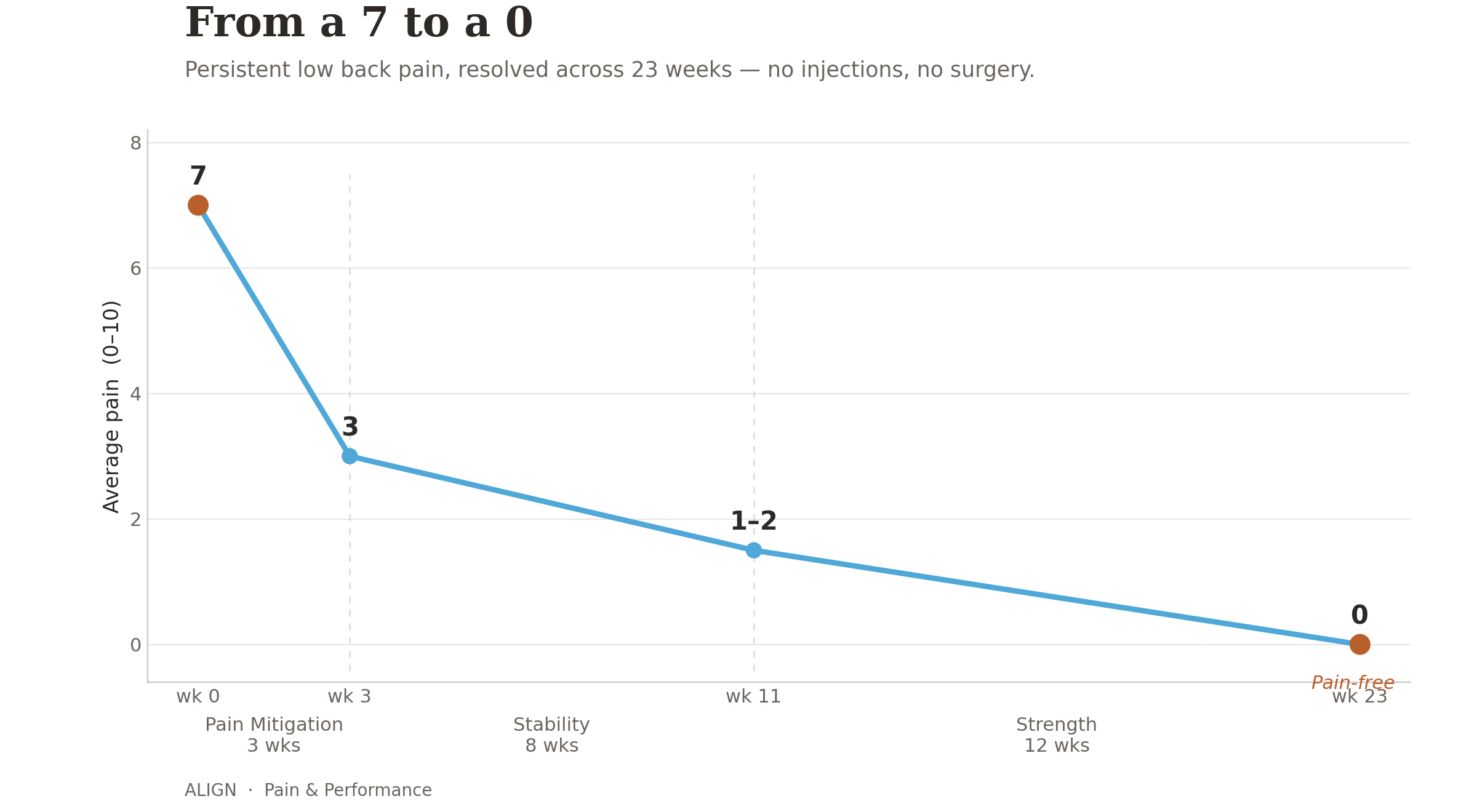
Result at 3 weeks: average pain 7 → 3 (a ~57% reduction). Notably less pain throughout the day, and she could walk longer without pain. She cleared the Pain Mitigation progression gates.
Phase 2 — Stability (8 weeks)
Goal: correct the neuromuscular weakness so the stabilizing muscles do their functional job.
Targets: glute medius, glute max, psoas, deep core, adductors, hamstrings, multifidus, and the arches of the feet.
Method: a series of spine and hip stability movements that force those muscles to engage — outer thigh raises, wall-supported clamshells (to guarantee movement quality), inner thigh raises, front leg raises, TVA holds, hamstring-emphasized hip bridges, and toe presses.
Result: complete return of function; average daytime pain 1–2, with residual morning pain of ~4 for the first 10–15 minutes only. She could now take long walks, stand and sit for extended periods, and work in her garden.
The job, however, was not finished.
Phase 3 — Strength (12 weeks)
Goal: build load-bearing capacity through lifestyle movement patterns, while maintaining the mobility and stability gains.
Patterns: squats, deadlifts, step-ups, calf raises.
Dosing: progressive overload with weekly load increases held to 5–10% — no more, no less — with adequate recovery. This is the stimulus that drives regenerative adaptation: denser muscle and connective tissue, cartilage (slowly), and bone density.
Benchmarks built: an 80 lb deadlift, step-ups with 40 total lbs, 30 single-leg calf raises, 2-minute planks (with deep-core stability intact), and 1-minute back extensions.
Result: average weekly pain 0; morning pain 0. She could walk, stand, and sit for as long as she wanted, lift heavy bags of soil in her garden, and pick up her grandchildren — something she could not do before.
On the lagging morning pain: residual morning stiffness that resolves last is often associated with connective-tissue or arthritic degenerative change. We reminded her throughout that connective tissue and cartilage are the last and slowest tissues to heal, so we would need to keep loading regularly and allow ~12 weeks for the adaptation. We cannot force healing — tissue healing rates are governed by blood supply, not by our desire for them to heal.
Outcome
Baseline: 7/10 average
End of Pain Mitigation (3 weeks): 3/10
End of Stability (+8 weeks): 1–2/10 (morning ~4)
End of Strength (+12 weeks): 0/10 (morning 0)
Full return to her stated goals: long walks, prolonged sitting and standing, gardening (including heavy loads), and picking up her grandchildren — achieved with no injections, no surgery, and no structural intervention.
What This Case Teaches
1. We don't exercise for exercise's sake. We exercise to build bodies capable of living the lifestyle we want to live. The deadlift was never the point; picking up a grandchild was.
2. Persistent pain never comes from one problem. It is always multiple — often dozens — of pain drivers that confuse and convolute the clinical picture. The key to resolving persistent pain is not "diagnosing the cause," which no one can reliably do. It is working a systematic process of excluding probable drivers, and continuing to fix and rule out drivers until the pain is gone and the strength is built to make the person's lifestyle easy.
3. Different pain drivers have different characteristics — so listen to the pain. What makes it better? What makes it worse? How long has it been present? What are the risk factors? Let the pain guide what you fix first, second, and third — and which professionals you bring onto the care team. Mechanical pain belongs with physical therapists, surgeons, and highly skilled trainers (few and far between). Nervous-system pain belongs with a neurologist, counselor, sleep-medicine physician, dietitian, or functional-health practitioner. Use the right tool for the right job; the wrong tool wastes time and money and lets the person slip deeper into the chronic pain spiral.
4. Build movement capability to the level where the lifestyle is easy — and make that the goal. Then be relentless about fixing the impediments along the way. Ultimately the body is a structure, made of materials, existing in Earth's gravitational field and bound by the laws of physics. Treat it like a building that must withstand gravity for the next 20–40 years. This is why decompression and pool therapy do not work long term: to be pain-free, we must possess the capacity to handle the load forces of our lives. We must be strong enough to exist under the weight of gravity — building capacity so we thrive under load rather than being crushed by it.